
The Seventh Bleaching of the Great Barrier Reef
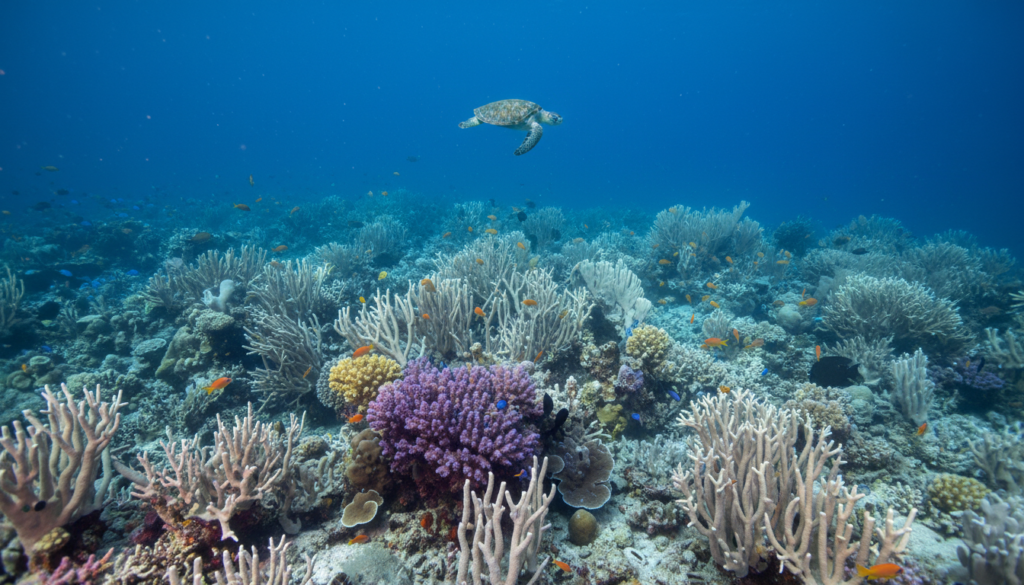
Seven times in ten years. Water temperatures rise and the Great Barrier Reef responds by shedding its color, a process now confirmed as the seventh mass bleaching event to occur within the last decade. This recurring cycle has shifted the focus of scientific observation from rare anomalies to a steady rhythm of change. Scientists are watching the reef closely. They see the white skeletons beneath the surface, yet they also see a system that continues to function despite the frequency of these heat-driven stresses.
A single reef system can span over 2,300 kilometers. In this vast space, billions of individual organisms work together to build the limestone structures we see from space. When these corals face prolonged environmental stress, they expel the tiny algae living in their tissues. This is the bleaching process. It leaves the coral pale and vulnerable, though not necessarily dead. Researchers are now looking at the frequency of these events to understand how the reef might adapt to a world where seven such events happen in only ten years.
The current situation raises sharp questions about what resilience looks like in practice. If a reef experiences seven mass bleaching events in a single decade, how does it manage to recover between them? Traditional conservation strategies are being re-examined. Scientists want to know if the reef can bounce back or if the interval between these events is getting too short for complete recovery. The data points to a changing reality.
Each event provides new information. We are learning how coral species differ in their reactions to heat. Some might stay vibrant while their neighbors turn snow-white. This variation is where the hope lies. It suggests a complexity that avoids a single, uniform outcome for the entire ecosystem.
Marine researchers have not yet specified which exact sectors of the massive reef system show the most significant change during this current event. They have not released data on specific mortality rates or sea surface temperature readings. This leads to a quiet period of waiting. Will the water cool in time for the coral to welcome back their symbiotic algae friends? No one knows for certain. The lack of immediate death rates reminds us that bleaching is a stress response, a temporary state that can still lead to survival if conditions shift.
Conservation strategies now involve a deeper look at these resilience patterns. Instead of viewing the reef as a static monument, it is being seen as a living, reacting entity. The seventh event in ten years is a number that stays in the mind. It is a data point that defines an era of marine science. Scientists continue to monitor the waters, gathering evidence on how the Great Barrier Reef navigates these recurring cycles.
There is an inherent uncertainty in watching a mass bleaching event unfold. We do not know if the eighth event is just around the corner or if a longer period of stability will follow. We only know that the seventh event has arrived. The reef remains a place of study and observation, where every white branch tells a story of a system under pressure but still very much alive. Global attention remains on the water. Researchers are documenting the resilience of these corals as they face a decade marked by transition. Survival is a quiet process. It happens in the weeks after the heat breaks, when the color begins to return to the sea floor. For now, the scientific community continues its work, documenting the seventh event and looking for the signs of endurance that define this marine icon.